On this page:
- What Is Food Traceability Software?
- Why Traceability Matters Now: FSMA 204 and Recall Readiness
- What to Look For in a Food Traceability Platform
- Types of Traceability Solutions
- How to Choose: A Short Evaluation Process
- Conclusion
- Key Takeaways
- Frequently Asked Questions
A single contaminated ingredient can touch dozens of finished lots within hours. The question that decides how bad a recall gets is simple: can you trace it in minutes, or does it take days? Food traceability software exists to make the answer "minutes" — and with the FDA's FSMA 204 rule reshaping recordkeeping for higher-risk foods, that capability is shifting from a nice-to-have to a requirement. This guide explains what food traceability software is, what to look for when evaluating it, and how to choose a system that fits your operation.
What Is Food Traceability Software?
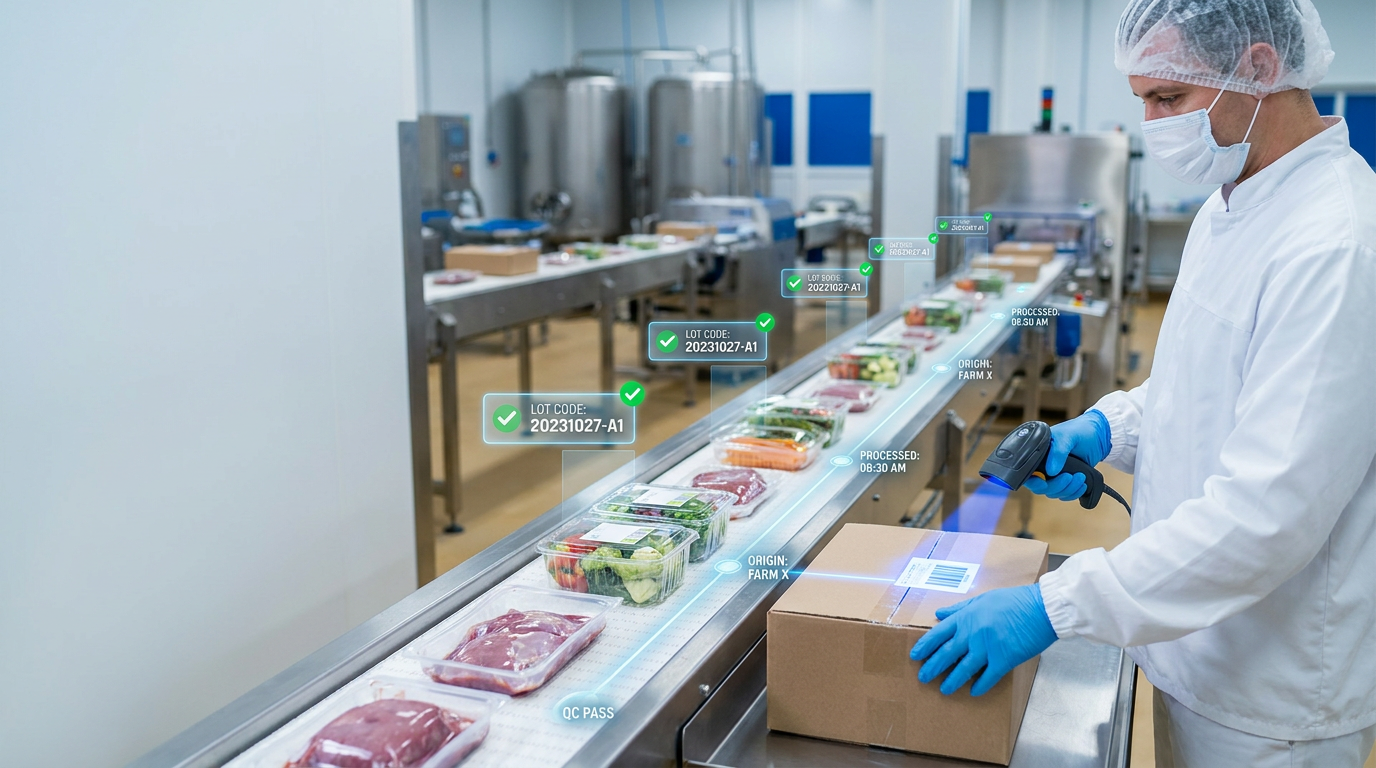
Food traceability software records the movement and transformation of food and ingredients — lot by lot — from the moment they arrive through production and out to shipping. Instead of scattered paper logs and disconnected spreadsheets, it maintains a linked digital record so you can answer, quickly and precisely, where any lot came from and where it went.
The baseline concept regulators expect is "one-up, one-down" traceability: for any lot, you can identify the immediate source it came from (one up) and the immediate recipient it went to (one down). Good software goes further, linking those steps into a continuous chain so a single lot code can reconstruct an entire history in one query rather than a manual hunt across systems.
Internal vs. external traceability
Internal traceability tracks lots as they move through your own process steps — receiving, mixing, cooking, packing. External traceability is the exchange of that data with your suppliers and customers, so the chain holds together across company boundaries. FSMA 204 effectively requires both: your records have to connect to the partners immediately before and after you in the supply chain.
Why Traceability Matters Now: FSMA 204 and Recall Readiness
For years, food traceability was something most manufacturers did to the minimum standard the law required — one step up, one step down, and hope you never had to use it. That's changing. The FDA's Food Traceability Final Rule, better known as FSMA 204, sets a far higher bar for a defined set of higher-risk foods, and it's reshaping how food businesses think about the records they keep.
Here's what the rule actually requires, in plain terms. If you manufacture, process, pack, or hold any food on the FDA's Food Traceability List (FTL) — which includes items like shell eggs, nut butters, certain soft cheeses, fresh-cut and leafy produce, and a range of seafood — you have to maintain enhanced records built around three concepts. You assign a Traceability Lot Code (TLC) to a lot when you first pack, receive, or transform it, and every record for that lot carries the same code so its history stays linked. You capture specific Key Data Elements (KDEs) — details like the lot code, product description, quantity, date, and location — at each Critical Tracking Event (CTE), which are the defined points along the supply chain where food is harvested, cooled, packed, received, transformed, or shipped. And you keep those records for two years, in a form you can hand to the FDA as an electronic sortable spreadsheet, within 24 hours of a request.
That 24-hour window is the part that quietly redefines everything. During an outbreak or recall investigation, the FDA can ask for a lot's full history and expect a clean, sortable answer within a day. If your receiving data lives in a warehouse system, your production records sit in a quality binder, your shipping data is buried in EDI exports, and your lot numbers live in a spreadsheet, producing that answer becomes a frantic manual reconciliation across disconnected systems — exactly when you can least afford the delay.
The deadline that trips up almost everyone
Most published guidance — and even parts of the FDA's own website — still cite a compliance date of January 20, 2026. That date is outdated. In March 2025 the FDA announced its intention to extend the compliance date by 30 months, and the current date is now July 20, 2028. Congress reinforced this in November 2025 by directing the FDA not to enforce the rule before that date, and the agency is complying.
But the extension moved only the deadline, not the requirements. The rule itself is unchanged, and the FDA has been explicit that it remains fully committed to implementing it. The reason for the delay wasn't a softening of intent; it was recognition that building genuine end-to-end traceability across thousands of trading partners takes time, because your records are only as good as the data your suppliers and customers can give you. Treating 2028 as a reason to wait is the trap.
The bigger reason: recalls don't wait for deadlines
Even setting the regulation aside, the same capability FSMA 204 demands is what determines how a recall plays out. When you can trace a contaminated lot forward to every customer who received it and backward to its source ingredients in a single query, you recall precisely what's affected and nothing more. When you can't, you recall broadly to be safe — destroying more product, absorbing more cost, and doing more brand damage than the actual problem warranted.
This is where the shape of your systems matters more than any single feature. A unified platform built for food processing that captures lot data across receiving, production, and shipping in one place turns that 24-hour request into a lookup rather than a fire drill — because the record already exists, linked by lot code, at the moment the FDA asks.
What to Look For in a Food Traceability Platform
Once you move past the basic definition, evaluating traceability software comes down to a handful of criteria that separate a system that genuinely protects you from one that just digitizes your paperwork. Use these as a checklist when you compare options.
Lot-level capture at every step
The system should capture lot data at every critical point — not just receiving and shipping, but transformation steps in between, where one lot becomes part of another. Gaps in the middle are where traceability chains break.
Automatic data capture, not re-keying
Every point where a human retypes a lot code is a point where errors enter. Look for capture driven by scanners, scales, and production equipment feeding the record directly. Automatic capture is both faster and far more accurate than manual entry.
Forward and backward recall simulation
A strong platform lets you run a mock recall on demand: pick a lot and instantly see both its source ingredients (backward) and every finished product and customer it reached (forward). If you can't simulate a recall in a single query during a demo, you'll struggle to do it in a real one.
Built-in FSMA 204 KDE/CTE support
Support for Key Data Elements and Critical Tracking Events should be native to the system, not a manual spreadsheet you maintain alongside it. The software should know what to capture at each event type and produce the electronic sortable output the FDA expects.
Unified platform vs. bolt-on tools
This is the criterion that most affects how you'll actually perform under pressure. When receiving lives in one tool, production in another, and warehousing in a third, assembling a lot's full history means reconciling data across disconnected systems. A unified platform that combines production, quality, and warehouse records keeps the whole chain in one place — so the 24-hour record request is a lookup, not a scramble.
Audit-readiness and record retrieval speed
Ask how quickly the system produces inspector-ready records. The regulatory standard is 24 hours; a good system does it in minutes, in the sortable electronic format the FDA specifies.
Integration with your existing systems
Traceability software rarely lives alone. Check how it connects to your existing ERP, warehouse, and production systems, and whether it supports standards like EDI for exchanging shipping data with trading partners.
Types of Traceability Solutions (and Who Each Fits)
Not every operation needs the same tool. Broadly, solutions fall into four categories.
Spreadsheets and manual records
Workable only for the smallest operations. They break down quickly as volume and supply-chain complexity grow, and they struggle to meet the 24-hour, sortable-format requirement. Not a realistic FSMA 204 path for covered businesses.
Point solutions
Single-function tools — for example, a warehouse-only system. Useful for a specific gap, but they leave you stitching multiple tools together to cover a full traceability chain.
Unified manufacturing platforms
Systems that combine production (MES), quality (QMS), and warehouse (WMS) functions in one place. These carry lot data continuously across every step, which is what makes end-to-end traceability and fast recall retrieval practical.
ERP modules
Broad business systems that may include a traceability component. They offer wide coverage but are sometimes shallow on shop-floor lot capture, so verify that lot-level tracking at transformation steps is genuinely supported, not just receiving and shipping.
How to Choose: A Short Evaluation Process
A practical way to work through a decision:
- Map your Critical Tracking Events — every point where lots are received, change, merge, or ship.
- List any FTL foods you handle and confirm which KDEs apply to your events.
- Score each candidate against the criteria above.
- Run a live recall simulation during the trial or demo — trace a lot both directions and time it.
- Check integration with your current systems and the total cost, including validation effort.
Questions to ask any vendor
- Can you show a lot traced forward and backward in one query, right now?
- How is lot data captured at transformation steps — automatically or by hand?
- Does the system produce the FDA's electronic sortable spreadsheet natively?
- How does it integrate with our ERP, WMS, and production equipment?
- What does record retrieval actually look like during a live FDA request?
Ready to achieve FSMA 204 compliance?
SG Systems Global provides digital traceability solutions that automate traceability lot codes, capture KDEs at every Critical Tracking Event, and generate audit-ready reports in seconds — not days.
Conclusion
Food traceability software has become the difference between a recall you contain in hours and one that spirals over days. FSMA 204 raises the stakes further, requiring covered businesses to produce linked, sortable lot records to the FDA within 24 hours. The compliance date is July 20, 2028 — which sounds distant, but coordinating traceability across an entire supply chain is slow work. The businesses that start now will meet the deadline comfortably and gain faster, cheaper recalls in the meantime. Your next step is simple: map your Critical Tracking Events and put any candidate system through a real recall simulation before you commit.
Key Takeaways
- The FSMA 204 compliance date is July 20, 2028 — the requirements are unchanged, so building traceability now avoids a last-minute supply-chain scramble.
- Under FSMA 204 you must produce a lot's full records to the FDA within 24 hours, in an electronic sortable format.
- Automatic, lot-level capture at every step — including transformation — is what keeps a traceability chain from breaking.
- The ability to simulate a recall forward and backward in one query is the single most revealing thing to test in a demo.
- A unified platform beats stitched-together point tools when the 24-hour clock is running.
Frequently Asked Questions
When is the FSMA 204 compliance date?
The FSMA 204 compliance date is July 20, 2028. It was extended 30 months from the original January 20, 2026 date. The rule's requirements are unchanged — only the enforcement deadline moved, and industry guidance is to prepare now rather than wait.
Who does FSMA 204 apply to?
FSMA 204 applies to businesses that manufacture, process, pack, or hold foods on the FDA's Food Traceability List (FTL). If your foods are not on the list, or you qualify for an exemption, the additional recordkeeping requirements do not apply.
What are Key Data Elements and Critical Tracking Events?
Critical Tracking Events (CTEs) are defined points in the supply chain — such as harvesting, cooling, packing, receiving, transforming, and shipping. Key Data Elements (KDEs) are the specific pieces of information — lot code, product description, quantity, date, and location — recorded at each event.
Is a spreadsheet enough for food traceability?
A spreadsheet can work for very small operations, but it breaks down at scale and struggles to meet FSMA 204's requirement to produce linked lot records to the FDA within 24 hours. Dedicated traceability software links records by lot code across every step, making retrieval fast and reliable.
How quickly must records be provided to the FDA under FSMA 204?
Records must be provided within 24 hours of an FDA request, or within a reasonable time the FDA agrees to, in an electronic sortable format when requested during an outbreak or recall.