Roughly 9.9 million foodborne illnesses occur in the U.S. each year, costing manufacturers an average of $10 million per recall incident. Understanding FSMA 204 requirements is the first step to building a compliance strategy that prevents costly recall scenarios. The FDA's Food Traceability Rule aims to cut tracing time by 83% and save between $2.5 billion to $18.8 billion over the next 20 years.
Understanding what is FSMA 204, the FSMA 204 requirements, and the FSMA 204 compliance date becomes essential for your operations heading into 2026. This comprehensive guide covers everything you need to know about FSMA 204 compliance, from the Food Traceability List to 24-hour reporting requirements.
On this page:
- Understanding FSMA 204
- Food Recall Statistics 2026
- What Recall Statistics Reveal About Traceability Gaps
- FSMA 204 Requirements: Building Compliance Systems
- Implementing Digital Traceability to Meet 2026 Standards
- Benefits of FSMA 204 Compliance Beyond Recall Prevention
- Conclusion
- Key Takeaways
- Frequently Asked Questions
Understanding FSMA 204: The Traceability Rule Explained
What is FSMA 204
The Food Safety Modernization Act introduced a change in 2011. It moved the U.S. food safety approach from reaction to prevention. FSMA section 204 builds on this foundation and addresses a gap that has plagued food safety for years: the inability to track high-risk foods during outbreaks quickly. This FSMA rule 204 gives the FDA boosted authority to establish systems that prevent foodborne illnesses and manage contamination events to work better.
Section 204(d) of FSMA establishes traceability recordkeeping requirements that go beyond existing regulations. The FSMA rule 204 applies to anyone who manufactures, processes, packs, or holds foods on the Food Traceability List. This includes farms, food facilities, restaurants, and retail food establishments, even those operating outside the United States. The standardized approach aims to close gaps in current systems that make it difficult to identify food origins during recalls.
The Food Traceability List (FTL)
The FTL identifies covered foods the FDA considers higher risk for foodborne illness outbreaks. Your operations fall under this rule if you handle soft cheeses (excluding hard aged varieties), shell eggs, nut butters (including all tree nut and peanut varieties), or fresh produce such as leafy greens, cucumbers, herbs, melons, peppers, sprouts, tomatoes, and tropical tree fruits. Fresh-cut fruits and vegetables also appear on this list of covered foods.
Seafood coverage extends to finfish in three categories: histamine-producing species like tuna and mahi mahi, species potentially contaminated with ciguatoxin such as grouper and barracuda, and species not associated with either concern including cod and salmon. The list further includes smoked finfish, crustaceans like shrimp and lobster, bivalve molluscan shellfish, and refrigerated ready-to-eat deli salads.
Critical Tracking Events and Key Data Elements
Critical Tracking Events represent specific points in your food supply chain where you must capture traceability data. These events include:
- Harvesting: Applies to farms removing raw agricultural commodities from where they're grown
- Cooling: Active temperature reduction through methods like hydrocooling or forced air cooling
- Original packing: The first-time packing of raw agricultural commodities
- First land-based receiving: When someone takes possession of food from a fishing vessel on land
- Shipping: When you arrange food transport from one location to another, including intracompany shipments
- Receiving: When someone other than a consumer accepts transported food
- Transformation: Manufacturing, processing, or changing a food when the output remains on the FTL
Key Data Elements vary by CTE but include traceability lot codes, product description, quantities and units of measure, location identifiers, shipping dates and times, and reference document numbers. These elements answer the what, where, when, who, and why of each event.
FSMA 204 Compliance Date and Timeline
Your business must comply by January 20, 2026, marking the critical FSMA 204 deadline. The final rule became effective on January 20, 2023, giving affected parties three years to implement required systems. You need recordkeeping procedures established, traceability lot code assignment methods documented, and a designated point of contact identified. Your traceability plan must include a farm map showing field locations with geographic coordinates if you grow or raise FTL foods other than eggs.
Food Recall Statistics in 2026: Current State of the Industry
Annual foodborne illness and recall data
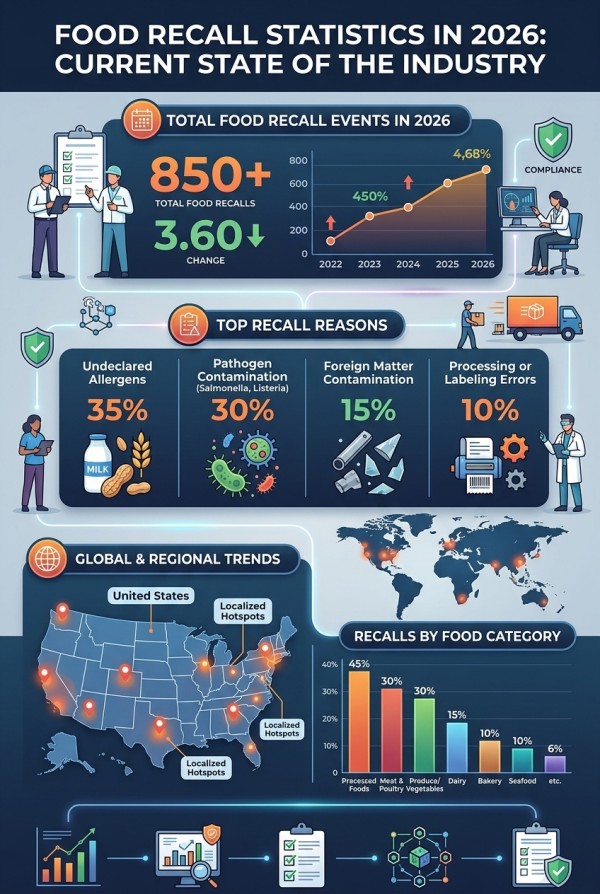
The FDA announced 320 food recalls in 2025, compared with 296 in 2024. This upward trend accelerated throughout the year. The agency issued 571 recalls in 2025, representing a 15.4% increase from the previous year. The volume affected expanded even more dramatically, reaching 138.5 million units — a 209% increase in just one year.
Outbreak investigation data paint an equally concerning picture. The FDA has investigated more than 50 foodborne illness outbreaks since 2024, responsible for causing at least 2,592 illnesses, 357 hospitalizations, and 27 deaths. Salmonella emerged as the dominant pathogen, linked to 15 outbreaks and 636 illnesses in 2025.
Economic effect of food recalls on manufacturers
The annual economic burden of foodborne illnesses acquired domestically reached $75 billion in 2023 dollars. The estimated average cost for a food recall stands at $10 million per incident for individual manufacturers, covering only direct costs such as retrieval and disposal of tainted products.
Factoring in indirect costs drives that figure higher. Lawsuits, sales losses, and damaged reputation compound the financial damage beyond containment efforts. Academic researchers estimated the cost of the November 2018-2019 E. coli outbreak in romaine lettuce to range from $276 million to $343 million.
What Recall Statistics Reveal About Traceability Gaps
Delayed contamination identification results in broader recalls
A multistate E. coli outbreak linked to romaine lettuce demonstrates why traceability gaps matter. The FDA initiated a traceback investigation on November 18, 2019, and requested records from 15 points of sale. The results revealed a stark contrast: 13 of the 15 locations lacked lot code traceability. The investigation consumed approximately one month to collect, analyze, and identify growers for these 13 retailers. The two locations with available lot codes identified growers within 24 hours or less.
Manual recordkeeping increases recall scope by 83%
Companies that rely on manual processes face trace investigations that consume hours or days, compared to minutes with automated systems. This time difference affects the scope of affected products and associated costs. Manual systems struggle with immediate traceability, especially when dealing with complex, multi-tier supply chains. Paper-based systems or scattered spreadsheets often fail to meet rapid retrieval requirements and lack adequate supply chain visibility.
Cost differences between traced vs. untraced recalls
The economic case for FSMA traceability becomes clear when you examine cost simulations. Perfect traceability limited the mean projected loss by more than 90% in a ground beef processor contamination scenario. Manufacturers waste over $275 billion annually on unnecessary product recalls — losses that could be prevented with reliable traceability systems.
FSMA 204 Requirements: Building Compliance Systems
Traceability Lot Codes and recordkeeping standards
Your FSMA 204 compliance system begins with proper traceability lot code assignment. You must assign a TLC when you originally pack a raw agricultural commodity (other than food from a fishing vessel), perform first land-based receiving of food from a fishing vessel, or transform a food.
Your traceability plan must describe procedures to maintain traceability documentation, including format and location. You need documented methods to identify FTL foods you handle and assign traceability lot codes. The plan requires a designated point of contact for traceability questions.
24-hour reporting requirements to FDA
You must provide all required records to the FDA within 24 hours of a request, or within a reasonable time to which the FDA has agreed. This includes an electronic sortable spreadsheet containing relevant traceability information when necessary during outbreaks, recalls, or other public health threats.
Technology solutions for data capture and sharing
Integration between systems makes accurate, timely traceability data possible at scale. GS1 US published guidance showing how X12 EDI 856 Advance Ship Notice supports Shipping CTE requirements. EDI platforms connect directly with ERP and warehouse systems, so traceability data flows into outbound documents automatically.
Cloud technology lets organizations track products both upstream and downstream while managing the complete product lifecycle. Digital traceability solutions should capture data from any source including apps, APIs, dashboards, or third-party platforms without disrupting workflows. Traceability software systems must generate audit-ready outputs automatically and produce compliance reports with chain-of-custody records in a single click. See how a unified platform like V5 Ultimate automates this entire process.
Ready to achieve FSMA 204 compliance?
SG Systems Global provides digital traceability solutions that automate traceability lot codes, capture KDEs at every Critical Tracking Event, and generate audit-ready reports in seconds — not days.
Building cross-functional compliance teams
Assemble stakeholders from operations, QA/food safety, supply chain, procurement, IT, and management. Everyone who handles food or records data, from field workers to warehouse staff, should be included to ensure your plan fits real processes.
Testing systems through mock recalls
Mock recalls should answer critical questions in under 2 to 4 hours internally. Your test must identify which supplier lot entered the facility, which production runs used it, which finished goods contained it, which warehouses received it, and which customers received those lots. Conduct these traceability audit drills for high-risk ingredients and monthly digital trace tests for complex formulas to identify compliance challenges early.
Benefits of FSMA 204 Compliance Beyond Recall Prevention
Reducing waste and optimizing inventory management
Digital traceability generates operational savings beyond regulatory compliance. Companies save up to $375,000 annually through improved operational efficiency alone. Food manufacturers report 30% reductions in food loss by identifying risk points and optimizing storage conditions.
Building consumer trust and brand protection
Transparency matters to 81% of shoppers both online and at brick-and-mortar stores. 59% of consumers remain reluctant to rebuy a recalled product. Your traceability investments show dedicated commitment to consumer safety, turning potential crises into opportunities to reinforce trust.
Cost savings from targeted recalls
The difference between recalling 2% of inventory versus 100% often determines whether an incident becomes manageable or catastrophic. Companies with sophisticated tracking isolate specific lots or batches instead of broad recalls affecting entire product lines. This precision preserves unaffected inventory and maintains customer relationships.
Don't wait until the deadline.
SG Systems Global helps food manufacturers achieve FSMA 204 compliance with digital traceability solutions that integrate with your existing ERP, WMS, and production systems.
Conclusion
FSMA 204 compliance represents more than regulatory obligation. Recalls increased 15.4% in 2025 and cost manufacturers an average of $10 million per incident. Your traceability investment protects both public health and your bottom line. Digital traceability solutions compress response times from weeks to hours and reduce recall scope by 83%. They save up to $375,000 each year through operational efficiency alone.
Your business has until January 20, 2026 to establish compliant systems. Companies that act now will turn this requirement into competitive advantage, building consumer trust and minimizing financial exposure during contamination events.
Key Takeaways
- Manual recordkeeping increases recall scope by 83%, while digital traceability systems can compress response times from weeks to hours during contamination events.
- Companies must comply by January 20, 2026, requiring traceability lot codes, 24-hour FDA reporting capabilities, and digital recordkeeping for high-risk foods on the Food Traceability List.
- Perfect traceability limits recall losses by over 90%, saving manufacturers from the average $10 million cost per recall incident through targeted product isolation.
- Digital systems generate $375,000 in annual operational savings beyond compliance, reducing food waste by 30% and eliminating manual tracking processes.
- 81% of consumers value supply chain transparency and will pay premium prices for traced foods, turning compliance investments into brand differentiation opportunities.
The statistics are clear: businesses that implement robust traceability systems before the 2026 deadline will not only meet regulatory requirements but also gain significant operational efficiencies, cost savings, and consumer trust that translate directly to competitive market advantages.
Frequently Asked Questions
What does the FSMA 204 traceability rule require from food businesses?
FSMA 204 requires food businesses handling high-risk foods to implement detailed recordkeeping systems that track products through the supply chain. This includes assigning traceability lot codes, capturing key data elements at critical tracking events, and being able to provide all required records to the FDA within 24 hours of a request. The rule applies to anyone who manufactures, processes, packs, or holds foods on the Food Traceability List.
Has the FSMA 204 compliance deadline been extended beyond January 2026?
While there have been discussions about extending the compliance date to July 20, 2028, the current official FSMA 204 deadline remains January 20, 2026. Businesses should prepare to meet this deadline by establishing compliant traceability systems, implementing digital recordkeeping, and conducting mock recalls to test their readiness.
What types of foods are covered under the FSMA 204 Food Traceability List?
The Food Traceability List includes high-risk foods such as soft cheeses, shell eggs, nut butters, leafy greens, cucumbers, herbs, melons, peppers, sprouts, tomatoes, tropical tree fruits, fresh-cut produce, various seafood species (including finfish, crustaceans, and bivalve molluscan shellfish), and refrigerated ready-to-eat deli salads.
How much can proper traceability systems reduce recall costs?
Perfect traceability can limit recall losses by more than 90% compared to systems without proper tracking. Companies with robust traceability can isolate specific contaminated batches instead of recalling entire product lines, avoiding the average $10 million cost per recall incident. Additionally, digital traceability systems generate up to $375,000 in annual operational savings through improved efficiency.
What are the main benefits of FSMA 204 compliance beyond avoiding recalls?
Beyond recall prevention, FSMA 204 compliance delivers significant operational benefits including 30% reductions in food waste, improved inventory management, faster response times during investigations, and reduced labor costs from automated tracking. Companies also gain competitive advantages through enhanced supply chain transparency, with 81% of consumers valuing traceability and showing willingness to pay premium prices for traced foods.